The Pilate Stone
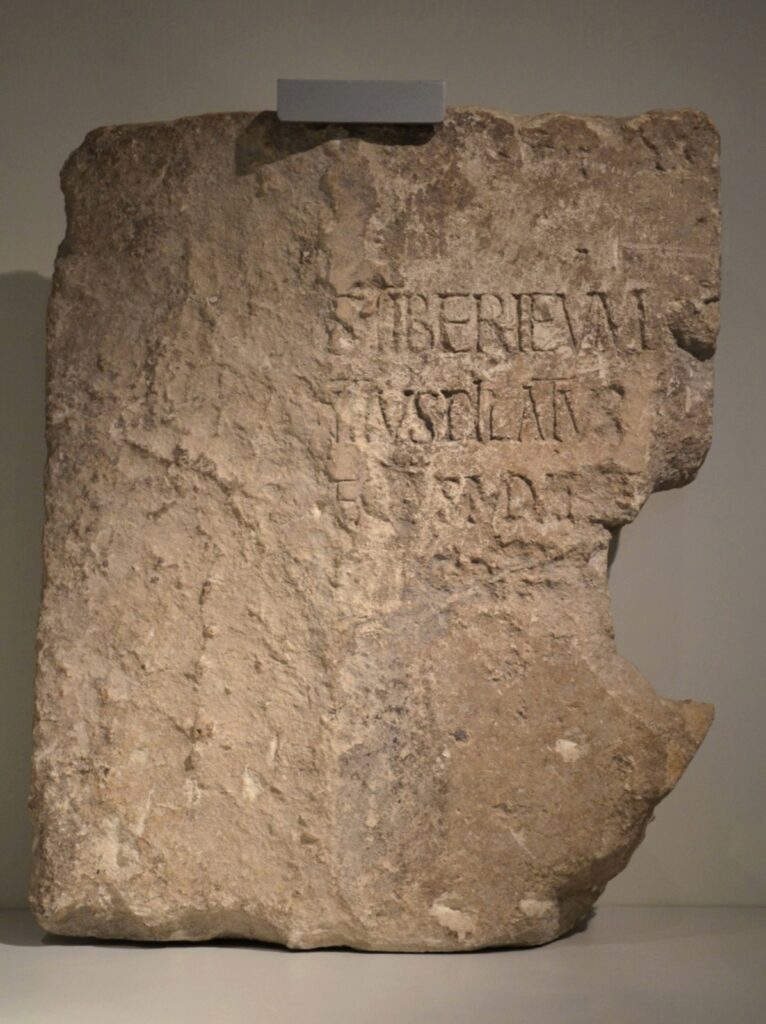

| What it is | A limestone block with a Latin building inscription, about 82 cm (2.7 feet) tall12 |
|---|---|
| Date | AD 26-36, the years Pilate governed Judea. Some scholars narrow it to AD 31-36.123 |
| Found | 1961, at Caesarea, by an Italian team led by Antonio Frova. It had been reused as a step in the Roman theater.45 |
| What it says | “… Pontius Pilatus, prefect of Judaea …” The first and last lines are mostly broken away.5 |
| Where it is now | The Israel Museum, Jerusalem (Israel Antiquities Authority no. 61-531). Copies are displayed in Milan and in Aalen, Germany.13 |
The Pilate Stone names Pontius Pilate, the Roman governor who sentenced Jesus, with his official title: prefect of Judea. It came out of a recorded excavation in 1961, and scholars treat the identification as certain. It shows that the governor in the Gospels was real and held power in Judea.
What it shows
Pilate was real, and he governed Judea. The stone names a Pontius Pilatus who was prefect of Judea. Lawrence Mykytiuk, writing for the Biblical Archaeology Society, says the identification “should be regarded as completely certain.”2
His title was prefect. Only the end of the word survives, “…ectus,” but the title isn’t in doubt.6 Encyclopaedia Britannica puts it simply: “That his title was prefect is confirmed by an inscription from Caesarea.”7
He put his name to a building honoring the emperor. The inscription mentions a Tiberieum, a structure named for the emperor Tiberius, who reigned when Jesus was crucified.5 Luke’s Gospel dates John the Baptist’s ministry by Tiberius’s reign and names Pilate as governor at the same time (Luke 3:1).
What it doesn’t show
It doesn’t mention Jesus. There’s no trial or crucifixion on the stone. It confirms the governor and the setting the Gospels describe, which is a different thing from confirming the events.
Much of it is restored. The first and last lines are mostly missing, so scholars disagree about what the Tiberieum was. Joan Taylor reads it as a dedication to the deified emperors.8 Géza Alföldy read it as the name of a lighthouse at Caesarea.3
It isn’t the only object that may name him. For years the Israel Museum described the stone as the only artifact recording Pilate’s name.1 In 2018, researchers read the name ΠΙΛΑΤΟ (Pilato) on a ring excavated at Herodium in 1968-69. Robert Cargill, writing for the Biblical Archaeology Society, thinks it more likely belonged to a regional administrator than to Pilate himself.9
Why it matters
The stone helps answer Did Jesus really exist? by fixing the man who sentenced him in history. It also settles a detail in Tacitus’s report on Jesus. Tacitus calls Pilate a procurator. The stone shows his official title was prefect. Later Roman writers routinely used the later title, so scholars treat Tacitus’s wording as an anachronism, not a mistake.6
Questions people ask
Is the Pilate Stone authentic?
Yes. It came out of a recorded excavation and was published the same year. None of the museum records, inscription databases, or scholarly studies used for this page questions it.3458
Where is the Pilate Stone now?
The original is in the Israel Museum in Jerusalem.1 Copies are displayed in museums in Milan and in Aalen, Germany.3
What does the Pilate Stone say?
The clearest lines read “[Po]ntius Pilatus” and “[praef]ectus Iuda[ea]e”: Pontius Pilate, prefect of Judea. Brackets mark letters that scholars restore.5 The rest is too broken to read with certainty.
Sources
- Israel Museum, <a href="https://web.archive.org/web/20150415211426/collection”>http://www.english.imjnet.org.il/Popup.aspx?c0=13142″>collection record for the Pilate inscription, archived April 15, 2015. Gives the date (26-36 CE), size, and IAA number 61-531. ↩︎
- Lawrence Mykytiuk, “30 People in the New Testament Confirmed,” Biblical Archaeology Society, accessed Oct. 11, 2026. Gives the size in feet, the most likely date (“between 31 and 36 C.E.”), and the identification as “completely certain.” ↩︎
- Epigraphic Database Heidelberg, “<a href="https://web.archive.org/web/20251207231612/HD004074″>https://edh.ub.uni-heidelberg.de/edh/inschrift/HD004074″>HD004074,” archived December 7, 2025. Gives the date range, the reading after Géza Alföldy, his lighthouse interpretation, and the copies in Milan and Aalen. ↩︎
- Lauren Montieth and Margaret Follett, “The Portrayals of Pilate,” Inscriptions of Israel/Palestine, Brown University, accessed Oct. 11, 2026. ↩︎
- Inscriptions of Israel/Palestine, “Caesarea 0043” (EpiDoc record), Brown University. Gives the find spot, the Latin text, and the English translation. ↩︎
- Lawrence Mykytiuk, “Did Jesus Exist? Searching for Evidence Beyond the Bible,” Biblical Archaeology Review, January/February 2015. Quotes A. N. Sherwin-White on “procurator” as an anachronism. ↩︎
- “<a href="https://web.archive.org/web/20260724034710/Pontius”>https://www.britannica.com/biography/Pontius-Pilate”>Pontius Pilate,” Encyclopaedia Britannica (archived copy, read Oct. 11, 2026). ↩︎
- Joan E. Taylor, “Pontius Pilate and the Imperial Cult in Roman Judaea,” New Testament Studies 52, no. 4 (2006): 555-582. ↩︎
- Robert Cargill, “Was Pontius Pilate’s Ring Discovered at Herodium?,” Biblical Archaeology Society, first published December 2018. ↩︎