Codex Sinaiticus
Codex Sinaiticus is a handwritten Greek Bible copied in the middle of the 4th century. It holds the earliest complete New Testament that survives. It lets anyone compare our Bible with a copy made nearly 1,700 years ago, and every surviving page is free to view online.
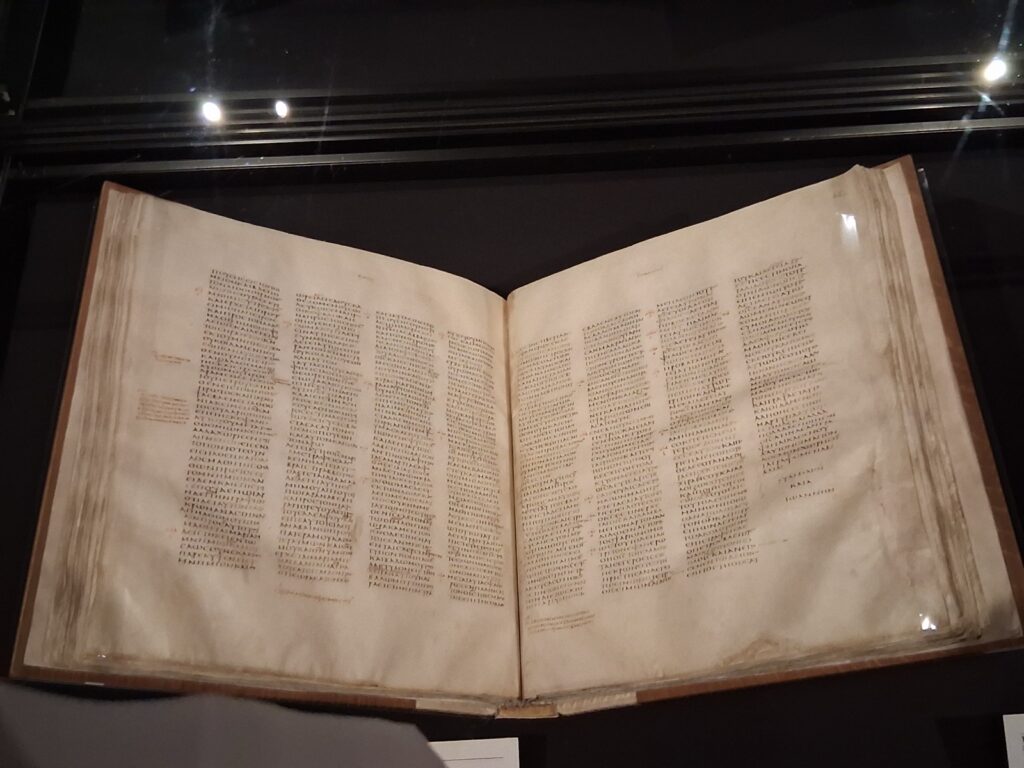

| What it is | A Greek Bible on parchment. It now has about half of the Old Testament (in the Greek version called the Septuagint), the whole New Testament, and 2 early Christian writings, the Epistle of Barnabas and part of the Shepherd of Hermas.123 |
|---|---|
| Date | The middle of the 4th century AD, dated from the handwriting.4 The British Library gives the 2nd to 3rd quarter of that century.3 |
| Size | Just over 400 leaves survive, each 38 by 34.5 cm (about 15 by 13.6 inches). Most pages have 4 columns of text.23 |
| Found | At St Catherine’s Monastery, Mount Sinai, Egypt. Constantin von Tischendorf obtained 43 leaves there in 1844 and took the largest part to Russia in 1859. More pieces turned up at the monastery in 1975.5 |
| Where it is now | Split among 4 places. The British Library, London, holds 347 leaves (Add MS 43725). Leipzig University Library has 43. The National Library of Russia has parts of 6, and St Catherine’s keeps at least 18 leaves and fragments.5 |
| See it online | Every surviving page, with a transcription, from the 4 libraries’ joint project6 |
What it shows
The New Testament, complete, from the 300s. The 4 holders describe it as containing “the earliest complete copy of the Christian New Testament.”1 Only one other nearly complete early Bible, Codex Vaticanus in Rome, is of a similar date.4
Whole books, in order. Sinaiticus is a different kind of witness from the scraps of papyrus that are older. It has whole books in order, so scholars can compare long stretches against later copies. The monastery’s own page notes that scholars think it and Vaticanus “preserve a very early level of the text.”7
Copyists and correctors at work. The project says it plainly: “No other early manuscript of the Christian Bible has been so extensively corrected.” The corrections run from the original scribes in the 4th century to the 12th century.8 Leipzig University Library counts “over 26,000” of them.9 That’s 800 years of readers checking and fixing a copy.
What it doesn’t show
It isn’t the original. It’s a copy, made roughly 250 to 300 years after the New Testament books were written. The project notes: “The only manuscripts of Christian scripture that are definitely of an earlier date than Codex Sinaiticus contain small portions of the text of the Bible.”4
It leaves out some familiar passages. Mark ends at 16:8, with the women leaving the empty tomb afraid. The longer ending, Mark 16:9-20, isn’t there.1011 Neither is the story of the woman caught in adultery (John 7:53-8:11), or the closing line of the Lord’s Prayer in Matthew 6:13, “For thine is the kingdom.”11 Modern Bibles note these passages because early copies like this one lack them.
It isn’t a perfect copy. Its scribes made mistakes, which is why it was corrected so many times.8 In general its text belongs to the family scholars call Alexandrian, but some readings, especially in John, follow a different family.12 Scholars weigh it alongside the other early manuscripts.
Is it a forgery? In 1862 Constantine Simonides, whom Tischendorf had earlier exposed for trying to pass off forged manuscripts, claimed he had written it himself as a young man.13 Henry Bradshaw of Cambridge University Library replied in 1863 that he was “as absolutely certain of the genuineness and antiquity of the Codex Sinaiticus as I am of my own existence.”13 All 4 institutions that hold it date it to the 4th century.4 J. K. Elliott’s 1982 study examined the claim in detail.3
How it left Sinai
This is still disputed, and the 4 holders say so. Their shared history says the events “are not fully known” and that they “have not come to a full accord.”5
Here’s what both sides accept. In 1859 Tischendorf signed a receipt for “the loan of the 347 leaves” and promised to return the codex “as soon as it was requested.”5 Tischendorf himself wrote that he received it “under the form of a loan.”14 In 1869 the Archbishop of Sinai and the monks signed a deed giving the codex to the Russian tsar.5 The monastery received 9,000 rubles.15 In 1933 Stalin’s government sold it to the British Museum for £100,000.5
The monastery’s view: Tischendorf promised to return it, and never did. He wrote that the leaves he first saw were about to be burned. “The monastery has always protested against this slander, and laments the loss of this manuscript.”7 Many historians have held that the monks gave it up under pressure from Russian diplomats.16
The other view: In 2009 a National Library of Russia researcher was allowed to see the 1869 agreement in the Russian foreign ministry archives.15 A. V. Zakharova, in a study published by the same library, examined Russian archive documents and concluded that the deed was signed “on their own free will, in accordance with the law, and without pressure from Count N.P. Ignatyev.”17
Why it matters
It answers a common question: has the Bible been changed? With Sinaiticus you can put a 4th-century New Testament next to your own Bible and see where they match and where they differ. The differences are known, and they’re listed in your Bible’s footnotes. Has the Bible been changed over time? takes that question across the whole Bible.
Questions people ask
Is Codex Sinaiticus the oldest Bible?
It’s one of the 2 oldest nearly complete Bibles, with Codex Vaticanus, and it has the oldest complete New Testament. Older papyrus copies exist, but they hold only parts of books.14
How is Codex Sinaiticus different from the King James Bible?
The King James Version was published in 1611, more than 2 centuries before Tischendorf brought Sinaiticus to Europe. Sinaiticus lacks some passages the King James includes, such as Mark 16:9-20, John 7:53-8:11, and the end of the Lord’s Prayer.11
Where is Codex Sinaiticus now?
Mostly in the British Library in London, with smaller parts in Leipzig, St Petersburg, and at St Catherine’s Monastery.5 You can see every page online.6
What does “Codex Sinaiticus” mean?
It means “the Sinai Book.”18 A codex is a book with pages, as opposed to a scroll.
Sources
- Codex Sinaiticus Project, “About Codex Sinaiticus” (archived October 19, 2026). ↩︎
- Codex Sinaiticus Project, “Content” (archived October 18, 2026). ↩︎
- British Library, catalog record for Add MS 43725 (archived December 6, 2022). Gives the size, 4 columns, the date, “the Shepherd (Pastor) of Hermas 1:1-27:6, 28:5-30:3,” and J. K. Elliott, Codex Sinaiticus and the Simonides Affair (Thessaloniki, 1982). ↩︎
- Codex Sinaiticus Project, “Date” (archived October 20, 2026). ↩︎
- Codex Sinaiticus Project, “History,” the text agreed by the British Library, Leipzig University Library, the National Library of Russia, and St Catherine’s Monastery (archived October 19, 2026). ↩︎
- British Library, “Codex Sinaiticus” (archived May 15, 2021). The pages were “reunited virtually in 2009.” ↩︎
- Holy Monastery of Saint Catherine, Mount Sinai, “Codex Sinaiticus” (archived August 30, 2025). ↩︎
- Codex Sinaiticus Project, “Significance” (archived October 18, 2026). ↩︎
- Leipzig University Library, “Codex Sinaiticus,” permanent exhibition (archived December 12, 2025). ↩︎
- Wikimedia Commons, “Ende Markusevangelium.jpg,” a photo of the page where Mark ends. ↩︎
- Biblical Archaeology Society, “What’s Missing from Codex Sinaiticus, the Oldest New Testament?,” Bible History Daily. ↩︎
- Smithsonian’s National Museum of Asian Art, “Codex Sinaiticus.” ↩︎
- G. W. Prothero, A Memoir of Henry Bradshaw (London, 1888), pp. 92-98, quoting Bradshaw’s letter to the Guardian, January 28, 1863. ↩︎
- Constantin Tischendorf, When Were Our Gospels Written? (New York: American Tract Society, 1866), p. 40. ↩︎
- Martin Bailey, “Key document on Codex Sinaiticus discovered,” The Art Newspaper, February 18, 2010 (archived). ↩︎
- A. V. Zakharova, “The History of the Acquisition of the Sinai Bible by the Russian Government in the Context of Recent Findings in Russian Archives,” introduction, National Library of Russia, 2009 (archived). She summarizes the earlier view of Ihor Ševčenko (1964), which “is still dominating scholarly opinion.” ↩︎
- A. V. Zakharova, same work, “Conclusions” (archived). ↩︎
- Codex Sinaiticus Project, “Name” (archived October 18, 2026). ↩︎
