Tel Dan Stele
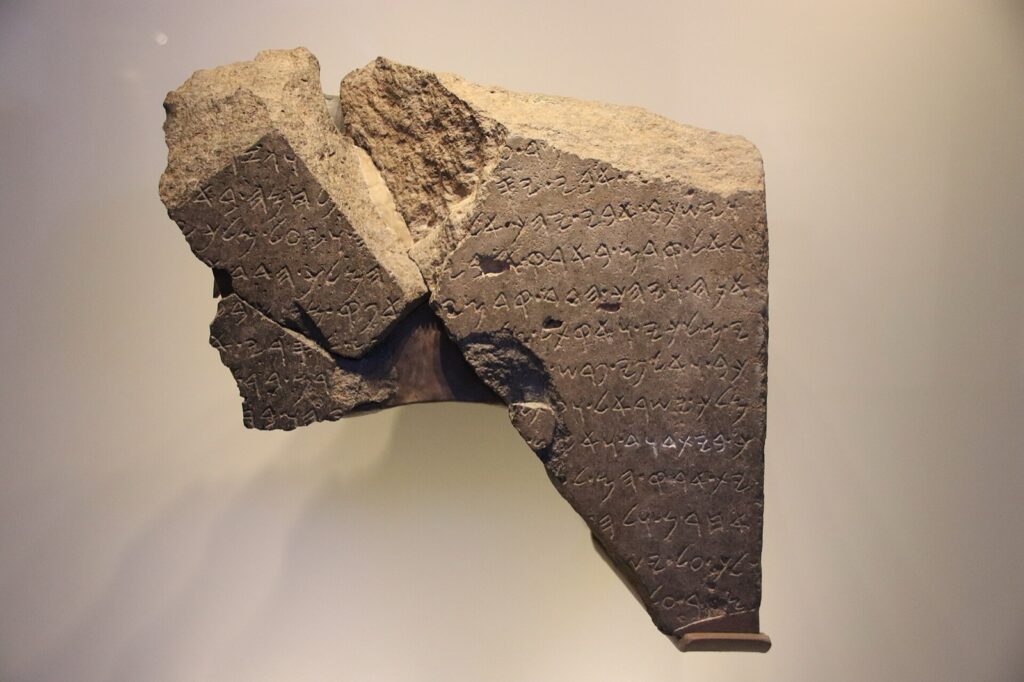

| What it is | Broken pieces of a black basalt victory monument, inscribed in Old Aramaic1 |
|---|---|
| Date | 9th century BC. Most scholars credit it to Hazael, king of Damascus. Eric Cline dates it to about 842 BC; a minority date it a few decades later.123 |
| Found | At Tel Dan in northern Israel, in an excavation directed by Avraham Biran. The largest piece turned up in July 1993, reused in a later wall. Two more pieces were found in June 1994.345 |
| What it says | “[I killed Jeho]ram son of [Ahab] King of Israel, and I killed [Ahaz]iahu son of [Jehoram] king of the house of David.” Names in brackets are restored by scholars.1 |
| Size | 34 by 32 cm (about 13 by 12.5 inches) with the pieces joined6 |
| Where it is now | Israel Antiquities Authority (nos. 1996-125 and 1993-3162). Lent to museums in Oklahoma, New York, and Washington in 2024 and 2025. Current display location to confirm.67 |
The Tel Dan Stele is a broken victory monument set up by one of Israel’s enemies in the 9th century BC. It claims credit for killing the “king of Israel” and a king of “the house of David.” Most scholars read it as the first evidence outside the Bible for David’s royal line.
What it shows
A dynasty named for David ruled Judah in the 9th century BC. The phrase “house of David” was a way of naming a royal family by its founder. Christopher Rollston puts it this way: the inscription “certainly refers to the Davidic dynasty.”1
Most archaeologists accept that reading. Eric Cline writes that “it is accepted by most archaeologists that the inscription is not only genuine but that the reference is indeed to the House of David.”2
It fits the kings named in 2 Kings. Jehoram of Israel and Ahaziah of Judah die in the same coup in 2 Kings 9, the events the stele describes from the other side.1
What it doesn’t show
It names David’s dynasty, not David himself. Rollston is careful here: “this inscription does not refer to David the historical figure.”1 It was carved more than a century after the traditional date of David’s reign.8
It doesn’t tell us how large David’s kingdom was. The Biblical Archaeology Society notes that “scholars have reached little consensus about the nature and extent of his rule.”4
It disagrees with 2 Kings about who killed the two kings. The stele’s author claims the killings. 2 Kings 9 credits Jehu. Rollston’s explanation is that the two were allies who each took credit.1
The restored names are reconstructions. The kings’ names are partly missing, and scholars still debate exactly how the pieces fit together.3
Why it matters
It’s an enemy’s record, carved more than a century after David’s reign, that treats his dynasty as a known fact.8 Evidence like that, from outside the Bible and from people with no reason to flatter Israel, is part of the case on Is the Bible reliable?
Questions people ask
Has the Tel Dan Stele been debunked?
No. In the 1990s some scholars suggested the key word could be a place name or mean “uncle,” “beloved,” or “kettle,” and some suggested a forgery.9 Those readings didn’t hold up with most scholars. Cline notes that “no serious scholar doubted the authenticity of the fragments,” and the “house of David” reading is the majority view.210
Does the Tel Dan Stele prove King David existed?
It doesn’t describe David. It shows that about a century after his time, a neighboring king knew Judah’s royal family as “the house of David.” Most scholars take that as strong evidence of a real founder named David.4
What does “house of David” mean?
The Aramaic letters are bytdwd. The majority of scholars read them as beth David, “house of David,” meaning the dynasty David founded.10 A minority read the word as a place name.
Sources
- Christopher Rollston, “The Tel Dan Inscription,” Bible Odyssey, accessed Oct. 11, 2026. Translation quoted without Rollston’s line numbers. ↩︎
- Eric H. Cline, “Did David and Solomon Exist?,” The Bible and Interpretation, October 2009, adapted from his Biblical Archaeology: A Very Short Introduction (Oxford University Press, 2009). Dates the stele to about 842 BCE. ↩︎
- D. Miller, review of Athas, The Tel Dan Inscription, Journal of Hebrew Scriptures 7 (2007). Gives the 1993 and 1994 finds and Athas’s later date of about 796 BCE. ↩︎
- “The Tel Dan Inscription: The First Historical Evidence of King David from the Bible,” Biblical Archaeology Society, accessed Oct. 11, 2026. ↩︎
- “‘David’ Found at Dan,” Biblical Archaeology Review 20, no. 2 (1994). Describes the surveyor Gila Cook spotting the first piece in a wall. ↩︎
- The Jewish Museum, “Tel Dan Stele,” exhibition, December 5, 2024 to January 5, 2025. Gives the size and the Israel Antiquities Authority numbers. ↩︎
- Museum of the Bible, “Tel Dan Stele,” exhibition, August 30 to November 3, 2025; and the Oklahoma showing, September 22 to November 25, 2024, announced by PR Newswire. ↩︎
- “David,” Encyclopaedia Britannica, accessed Oct. 11, 2026. ↩︎
- “A House Divided: Davies and Maeir on the Tel Dan Stela,” Biblical Archaeology Review, January/February 2013. ↩︎
- “Israel,” Encyclopaedia Britannica, accessed Oct. 11, 2026. ↩︎